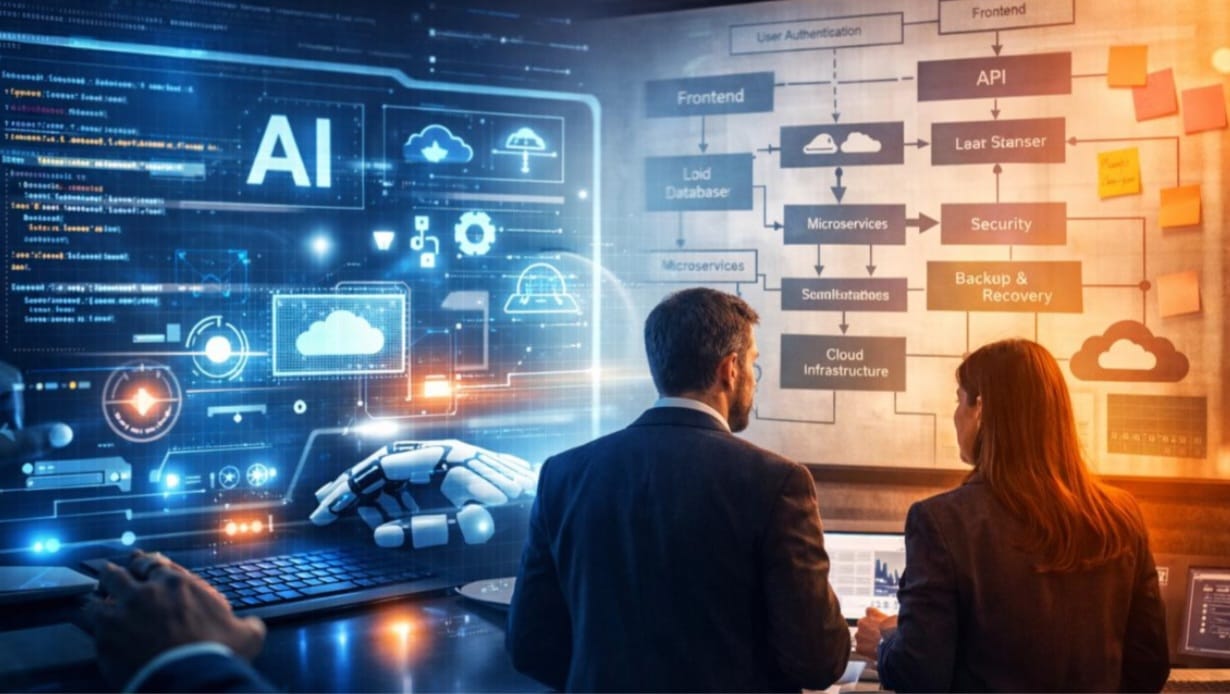
Engineering Beyond AI: 5 Predictions for the Next Decade of Software Engineering
AI will accelerate code generation and development workflows. But reliable systems will still depend on engineering judgment, verification, security, and accountable teams.

Software engineering is entering a period of significant change.
AI-powered development tools can now assist with code generation, debugging, test creation, documentation, and repository analysis. Autonomous coding agents are also expanding the scope of tasks that can be delegated to software.
These capabilities are changing how developers work.
However, faster implementation does not automatically translate into better software. A generated solution still needs to satisfy business requirements, fit the existing architecture, protect data, and behave reliably under real operating conditions.
The 2025 DORA report on AI-assisted software development describes AI as an amplifier of existing organizational strengths and weaknesses.
That makes the next decade an interesting engineering challenge: how do we increase the benefits of AI without weakening the practices that make software dependable?
Here are five developments worth preparing for.
- Verification will become a core part of AI-assisted development
As AI generates more code, teams will need reliable ways to validate it.
Traditional software quality practices remain relevant, but the volume and speed of AI-assisted changes may put additional pressure on them.
Consider an AI-generated change to a payment or account-management service.
Even if the implementation compiles and passes basic tests, engineers still need to evaluate:
Functional correctness and business rules.
Authentication and authorization.
Input validation and error handling.
Data integrity and transaction boundaries.
Performance under expected workloads.
Compatibility with existing services.
Logging, monitoring, and recovery behavior.
This requires more than adding another automated check.
Teams should build a verification pipeline that combines automated testing, static analysis, security scanning, integration testing, code review, and production monitoring.
The objective is to make verification repeatable and proportionate to the risk of each change.
- AI will raise the baseline of engineering productivity, but not replace experience
AI assistants reduce the effort involved in understanding unfamiliar code, exploring APIs, generating examples, and debugging common problems.
This can help developers become productive in areas that previously required significant preparation.
But technical assistance and engineering experience are not the same.
An engineer may generate a working implementation without understanding its long-term implications. They may not recognize an architectural inconsistency, an operational dependency, or a security assumption.
This distinction matters when building complex systems.
Organizations should use AI to support structured learning:
Encourage developers to explore alternative implementations.
Use AI-generated explanations as a starting point for technical discussions.
Ask engineers to explain the reasoning behind their changes.
Pair less experienced developers with reviewers who can provide context.
Give teams opportunities to work on architecture and production issues.
The opportunity is not to remove the learning curve. It is to make learning more effective.
- Engineering judgment will become a differentiator
As routine implementation work becomes easier to automate, the ability to evaluate decisions will become increasingly important.
A generated implementation can be syntactically correct and still be unsuitable for the application.
For example, an AI assistant might suggest adding a new service to handle a specific business capability. The design may look reasonable, but an architect or senior engineer should evaluate:
Does the new service justify the operational complexity?
Are service boundaries appropriate?
How will data consistency be maintained?
What happens when dependent services fail?
Does the design introduce unnecessary network calls?
Can the team operate and maintain the additional infrastructure?
These questions require knowledge of the complete system, not just the code being generated.
The same principle applies to automated code review.
An AI reviewer may identify common defects, but human reviewers still need to understand business logic, authorization boundaries, and system-specific risks.
Our article on code review for autonomous coding agents explores this evolving responsibility.
- Security and accountability will be built into engineering workflows
AI-assisted development introduces risks that teams need to address throughout the software lifecycle.
These can include sensitive data exposure, insecure dependencies, prompt injection, excessive tool permissions, and unvalidated generated outputs.
Engineering teams should establish clear controls around:
Identity and permissions: Ensure services, developers, and AI agents have only the access they need.
Data protection: Define how sensitive information is accessed, processed, stored, and shared.
Input and output validation: Treat external inputs and model-generated content as untrusted until validated.
Auditability: Maintain appropriate records of important actions and decisions.
Human oversight: Define approval requirements for sensitive or irreversible operations.
The importance of these controls increases in regulated industries.
Healthcare, fintech, and life sciences organizations may have specific legal, contractual, and assurance requirements depending on their systems, jurisdictions, and organizational responsibilities.
The NIST AI Risk Management Framework highlights documented responsibilities and human oversight as part of AI risk management.
This means accountability cannot be left to the model or tool provider. Organizations must establish who approves changes, who owns production outcomes, and how risks are addressed.
For a closer look at security integration, see our guide to embedded security engineering in fintech.
- Engineering metrics will shift from output to outcomes
AI can increase the number of lines of code generated, pull requests created, and tasks completed.
But these are activity metrics, not necessarily indicators of better software delivery.
A more meaningful evaluation should consider:
Engineering dimension Useful indicators
Code quality Defect rates, maintainability, escaped bugs
Delivery performance Lead time, deployment frequency, release consistency
Reliability Change failure rate, recovery time, service availability
Security. Vulnerability trends, remediation time, policy adherence
Developer effectiveness Time spent on repetitive work versus problem-solving
Business outcomes. User experience, operational efficiency, delivered value
Teams should compare these outcomes over repeated releases rather than drawing conclusions from a short-term increase in AI usage.
A faster workflow is valuable only when it improves the quality, reliability, or business impact of the software.
Preparing engineering teams for the next decade
Organizations do not need to predict every AI breakthrough to prepare for the future.
They can start by strengthening capabilities that remain valuable across changing tools and platforms.
A practical approach includes:
Improve engineering foundations: Invest in architecture, testing, infrastructure, security, and observability.
Introduce AI with clear boundaries: Define which tasks can be automated and which require human review or approval.
Strengthen technical mentoring: Make design reasoning, debugging, and system understanding part of everyday learning.
Make ownership visible: Identify who reviews, approves, deploys, and supports consequential changes.
Measure real outcomes: Track quality, reliability, maintainability, and user value alongside development speed.
These practices help teams adopt new capabilities without losing control of the systems they build.
Final thoughts: The future is engineering beyond AI
The next decade will bring more capable models, better development assistants, and increasingly autonomous workflows.
But software engineering will remain a discipline of decisions and consequences.
Teams will still need to understand requirements, challenge assumptions, evaluate trade-offs, protect users, and respond when systems fail.
The organizations that benefit most from AI will not necessarily be those that automate the largest number of tasks. They will be those that combine automation with strong engineering fundamentals and clear accountability.
AI can make development faster. Engineering discipline makes the results dependable.
That distinction will matter long after today's tools have changed.
About the author
- Healimpilo is technology advisory firm helping healthcare, fintech, life sciences, and SaaS companies build secure, scalable, and compliant digital platforms.
Comments
Join the discussionNo comments yet. Be the first to comment.